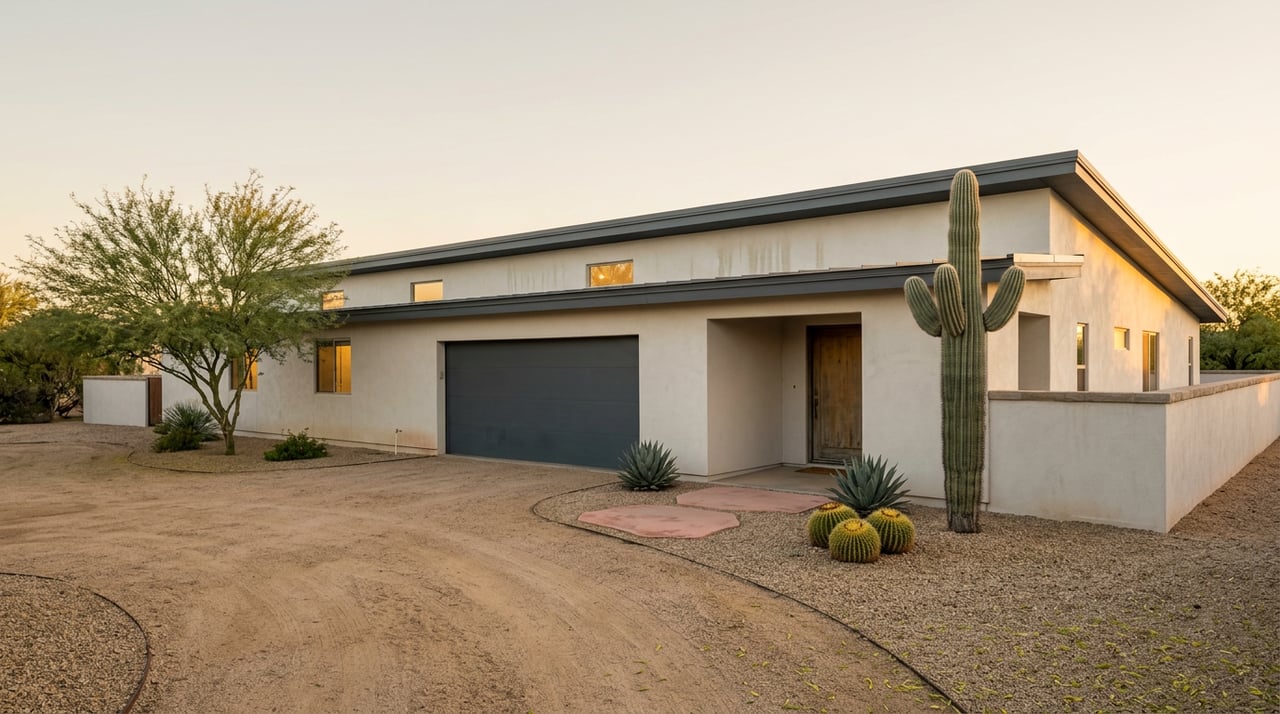
Marana likes to tell buyers it doesn't have a townwide property tax, and that's true. The town collects sales tax and development fees, not a general property levy the way Tucson or Oro Valley do. What that pitch leaves out is that a good share of the homes buyers actually tour in Marana sit inside a Community Facilities District, a special taxing authority that shows up on the Pima County tax bill as its own line, separate from the county, the school district, and the fire district. It's legal, disclosed, and has been part of how Marana builds infrastructure since 2004. It's also the reason two homes with nearly identical list prices in Marana can carry different real monthly costs, and the difference has nothing to do with square footage.
The mechanism nobody points to during the tour
A Community Facilities District, or CFD, is a separate political subdivision under the Arizona Constitution. It can issue bonds and levy taxes on its own, independent of the Town of Marana, to pay for the roads, water lines, and sewer infrastructure that make a master-planned community buildable in the first place. The Town of Marana's Special Districts page explains the basic setup: a CFD finances installation, operation, and maintenance of public infrastructure that benefits the community it sits inside, and the Town Council typically serves as its board.
That structure means the town isn't on the hook if a CFD's bonds go bad, but the homeowner inside the district boundary is, for as long as the bonds are outstanding. As Marana's town attorney put it when the Saguaro Springs CFD was being formed, it functions like an improvement district, with the intent that the infrastructure gets paid for through a property tax specific to that neighborhood, because Marana doesn't have one at the town level to draw from otherwise.
What the established districts are actually charging
Four of Marana's best-known master-planned neighborhoods carry a CFD: Gladden Farms, Gladden Farms Phase II, Saguaro Springs, and Vanderbilt Farms. A fifth, Dove Mountain, has its own CFDs too, but with a different oversight setup worth noting below.
| District | Rate per $100 of secondary assessed value | Governed by | What's distinct |
|---|---|---|---|
| Gladden Farms CFD | $2.80 ($2.50 debt service, $0.30 operations and maintenance), unchanged from FY2020-21 through FY2024-25 | Marana Town Council | Formed by petition in February 2004, the town's original CFD |
| Gladden Farms Phase II CFD | Same $2.80 rate and split, unchanged through FY2024-25 | Marana Town Council | Formed in December 2007 to cover the neighborhood's later build-out |
| Saguaro Springs CFD | Capped at $2.80, same $2.50/$0.30 split, unchanged FY2021-22 into FY2022-23 | Marana Town Council | Approved when the land was already cleared and roads already in, ahead of homes going in |
| Vanderbilt Farms CFD | Rate not itemized in the county documents reviewed for this piece | Marana Town Council | One of Marana's four original CFDs |
| Dove Mountain CFDs | Rate not itemized in the county documents reviewed for this piece | An independent board, not the Marana Town Council | The only Marana district family the Town Council chose not to govern directly |
The consistency across Gladden Farms, its Phase II district, and Saguaro Springs isn't an accident. Marana's CFD policy guidelines set a target rate for routine infrastructure financing and hold it there once the bonds are sized and sold. Once a district hits its cap, it tends to stay flat year after year, which is exactly what the county's own budget filings for these three districts show across four straight fiscal years.
The newest entrant hasn't settled yet
Mandarina, the master-planned community now selling homes from Meritage Homes, KB Home, and Lennar off Tangerine Road, has its own CFD too. It shows up as a distinct secondary-tax line in Pima County's FY2026/27 tax-authority levy report, separate from every legacy Marana district. KB Home announced the grand opening of two new neighborhoods inside Mandarina, Reserve and Horizon, at the end of October 2025, and the CFD attached to the master plan is still young by comparison to Gladden Farms' two-decade-old district.
That youth matters. A CFD's rate isn't fixed at formation. It's set to hit a debt service target each year, which means the levy tends to climb as a developer issues more bonds to build out later phases, then flattens once the district reaches its capped rate the way Gladden Farms and Saguaro Springs have. A buyer looking at a Mandarina listing today is looking at a district still early in that curve, not a settled number they can assume will stay put.
What happens when a proposed district asks for too much
The clearest illustration of how far these rates can swing came when Marana's Town Council reviewed a proposed CFD for the Villages at Tortolita, a large planned community north of the San Lucas neighborhood. The developer, TMR Investors, projected an average home price of $260,000 in the district and asked for a tax rate of $4.55 per $100 of assessed value, which the Tucson Local Media coverage reported would translate to roughly $1,225 a year for the typical homeowner at the time of purchase.
Council members pushed back hard. They had previously agreed new Marana homeowners shouldn't pay more than $100 a month in CFD tax, and $4.55 per $100 put the proposal right at that ceiling with little room to spare. That's more than 60 percent higher than the $2.80 rate every established Gladden Farms-family district has held for years. The proposal stalled over exactly this gap. It's a useful data point for any buyer comparing communities: the $2.80 rate isn't a law of nature. It's the number Marana's existing districts happened to land on, and a new development can propose something well above it if the town lets it through.
Why the same list price can mean a different monthly number
None of this means Marana is a bad place to buy. It means the sticker price on a listing inside Gladden Farms, Saguaro Springs, or Mandarina isn't the full monthly cost, and homes in Marana's older, CFD-free pockets aren't competing on the same basis as homes inside these districts, even when they're priced within a few thousand dollars of each other.
The rate itself, $2.80 per $100 of secondary assessed value for the established districts, only tells part of the story too, because secondary assessed value isn't the same number as the purchase price. The actual dollar impact depends on the specific parcel's assessed value, which is exactly why buyers comparing two Marana communities should pull the Pima County Treasurer's tax statement for the actual address in question rather than estimating from a listing price alone. That statement will show every taxing authority attached to a parcel, CFD included, with the current levy.
Questions buyers ask once they see the line item
Does every Marana home have a CFD charge? No. Older, established parts of town and neighborhoods built before a CFD was formed don't carry one. The charge only applies inside the specific boundary a district was created to serve.
Where does the CFD tax show up if it's not part of the sale price? It appears on the Pima County property tax statement as a secondary tax authority, listed separately from the county's general levy, the school district, and any fire district covering the parcel.
Can a CFD rate go up after I buy? It can move within the district's approved cap as the board sets each year's budget to meet debt service, though established districts like Gladden Farms have held their rate flat for several years running once they reached their target.
If you're weighing a home in Gladden Farms against one in Mandarina, or wondering whether an older, CFD-free part of Marana fits your budget better once you run the real numbers, Genardini Realty Solutions can walk through the specific parcel's tax statement with you before you write an offer, not after you're already in escrow wondering what that extra line is. Reach out through our buyer resources page, or if you're comparing what your current home could fetch against a move into one of these communities, start with a home valuation so you're working from your real numbers on both sides of the deal.