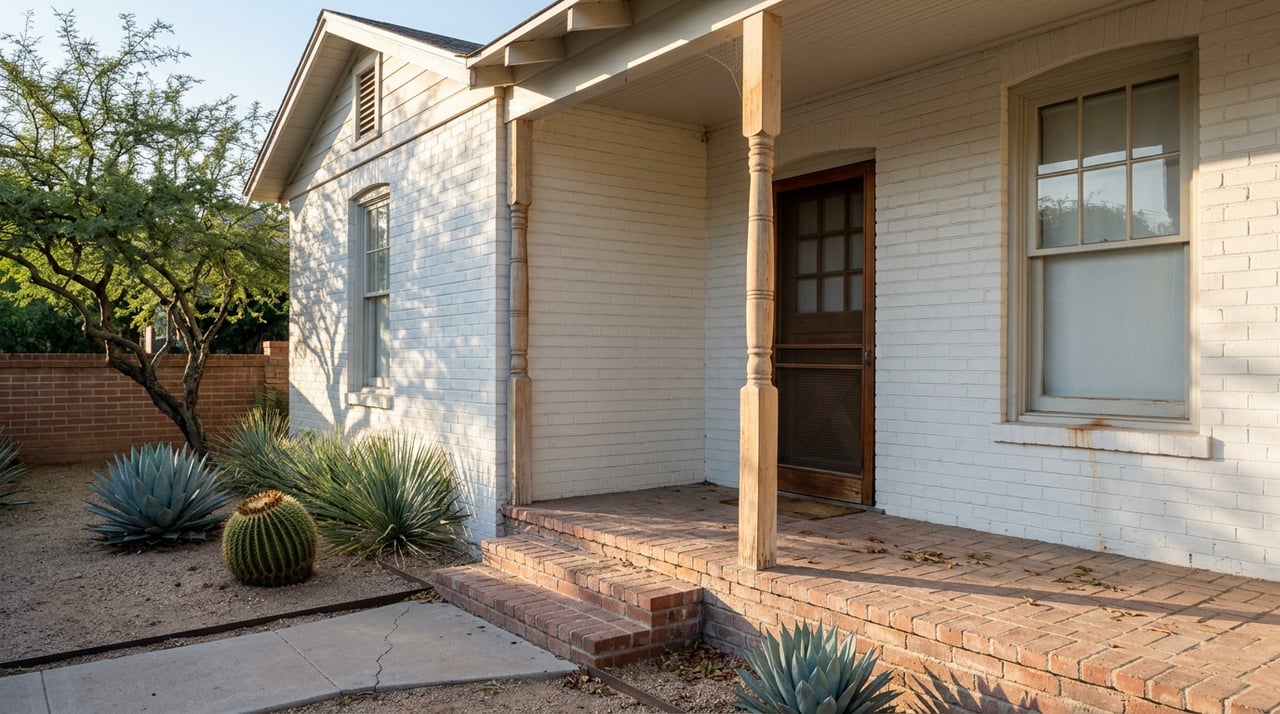
Picture the timeline most buyers expect after closing on a home in El Presidio or Armory Park: movers, a change of address form, maybe a new coat of paint. What actually shows up in the mailbox a few weeks later, for a share of these buyers, is a letter from the Arizona State Historic Preservation Office asking for a Change of Ownership Affidavit and two photographs of the house.
That letter is the moment a lot of buyers realize the historic designation on their new address is not a plaque or a marketing line. It is an active administrative relationship between the property and the state, one that started before they arrived and keeps running unless someone tells it to stop. Understanding how that relationship works, what it's worth in dollars, and how easily it can be broken is the difference between buying a historic home in downtown Tucson with your eyes open and finding out the hard way.
The Label You Inherit, Not Just the House
Downtown Tucson's historic housing stock sits inside several distinct Historic Preservation Zones, each one a City of Tucson zoning overlay layered on top of the underlying residential zoning. El Presidio, roughly a twelve-block area just north of the downtown government core, was designated a city HPZ in 1975 and added to the National Register the following year. West University became a city HPZ in 1984, after its National Register listing, and a 1995 survey of the district counted more than 600 buildings as contributing historic properties. Armory Park has its own advisory board structure, as does El Presidio. Barrio Historico, sometimes called Barrio Viejo, holds some of the oldest surviving adobe buildings in the country.
Inside each of these zones, not every home carries the same status. A property is either "contributing," meaning it retains the architectural features that justified the district's listing, or "non-contributing," meaning something about it, often a past remodel, disqualifies it from that status even though it sits inside the boundary. This distinction is not cosmetic. It determines whether the home can participate in the tax program described below, and it is worth confirming with the City of Tucson's historic preservation office before you write an offer, not after.
The Tax Break That Comes With the Address
Arizona's State Historic Property Tax reclassification, administered by the State Historic Preservation Office alongside county assessors, is the single biggest financial detail buyers miss. The program works by changing the assessment ratio used to calculate property tax on an owner-occupied, contributing historic home from the standard residential ratio down to half of that. In practical terms, a property valued the same way twice, once under the normal ratio and once under the historic ratio, produces two very different assessed values:
| Standard residential ratio | Historic (SPT) ratio | |
|---|---|---|
| Assessment ratio | 10% | 5% |
| Assessed value on a $100,000 property | $10,000 | $5,000 |
That shift translates to a property tax reduction in the range of 35 to 45 percent, according to the Arizona State Parks program page that administers it, with the exact figure depending on local special assessments your county assessor can confirm.
Here is the part most buyers do not expect: this reclassification is tied to the property, not the person who applied for it. If the home you're buying is already enrolled, the reduced tax status survives the sale. But it does not update itself. The new owner has to file a Change of Ownership Affidavit with the state and submit fresh photographs to keep the record current. Skip that step and the paperwork trail gets messy at your next tax notice.
How a Previous Owner Can Quietly Undo It
The reclassification comes with strings, and those strings are why some homes that sit inside a historic district boundary are not actually enrolled, or worse, used to be contributing and no longer are. Any exterior work visible from the street has to be reviewed and approved by the state before it happens. Homeowners who add features that obstruct the view of the house from the street, or who build additions inconsistent with a contributing property's period and style, can lose that status entirely. Reporting on a past legislative attempt to roll back the program, the Arizona Daily Star quoted Tucson's historic preservation officer describing exactly this pattern, homeowners whose additions changed their homes' status from historic to non-historic.
A few situations that can break the reclassification or keep a home from qualifying in the first place:
- An addition or exterior change completed without SHPO review, even if it complied with the city's building permit process
- Renting the home to anyone other than immediate family, since the program requires owner occupancy for the residential classification to apply
- Allowing the property to fall below the maintenance standards set by the Arizona State Parks Board, since compliance is checked periodically over the program's 15-year term
If you're buying a home that is not currently enrolled, ask why. Sometimes it's simple, the current owner never applied. Sometimes it's because a past renovation quietly disqualified the house, and that history is worth knowing before you plan your own updates.
What Changes Once You're the Owner
Owning a contributing property in one of these zones means any future exterior work, from a new roof to a rebuilt porch, goes through design review before it goes through a hammer. That review typically adds four to six weeks to a renovation or addition timeline compared to a non-historic property, since plans have to pass through the zone's advisory board, whether that's the Armory Park Historic Zone Advisory Board or the equivalent review process for El Presidio, before the city issues a permit. The good news, according to the state's own FAQ on the program, is that paint color and landscaping choices generally fall outside this review. It's the structural and visible-from-the-street changes that require sign-off, not your choice of trim color.
If you're the kind of buyer who already has a punch list of updates planned for a Craftsman bungalow in West University or a Sonoran-style adobe in El Presidio, build that review window into your renovation budget and schedule from day one. It is far easier to plan around than to discover mid-project.
Why the Inspection Does More Work Here
Historic homes downtown carry the systems and construction methods of their era, adobe and brick walls, original plumbing runs, electrical that has been added to in layers over a century. A standard inspection still applies, but the findings interact with the historic preservation framework in a way a newer home's inspection does not. If your inspector flags an addition or alteration you weren't aware of, that's worth cross-referencing against the property's contributing status before you assume it's a simple repair item. What looks like a straightforward fix on paper might be the very change that disqualified the home from the tax program years ago, and any correction you make will need its own review.
What This Costs You in Today's Market
Across greater Tucson, homes sold for a median of $320,000 over the three months ending May 2026, with the typical home taking about 65 days to sell. That citywide figure is a useful baseline, but it tells you almost nothing about a contributing property in El Presidio or Armory Park. These homes are not fungible. There is a fixed, non-expanding supply of adobe and early-1900s bungalows inside these boundaries, and no amount of new construction elsewhere in the metro adds to it. When you're comparing a listing's price to "the Tucson market," remember you're actually shopping a much smaller, much slower-refilling shelf.
Quick Answers
Does the historic tax break transfer automatically when I buy a contributing property? The reclassification stays with the property through a sale, but you still need to file a Change of Ownership Affidavit with the State Historic Preservation Office and submit current photographs to keep the record active in your name.
Can I paint my historic home any color I want? In most cases, yes. Paint color and landscaping generally fall outside the review requirement. Structural changes and additions visible from the street do not.
How much longer should I expect a renovation to take? Plan for four to six additional weeks compared to a non-historic property, to allow time for the applicable advisory board's design review before the city issues a permit.
Where This Leaves You
None of this makes a historic downtown Tucson address a harder buy. It makes it a different kind of buy, one where the paperwork is part of the property. If you're weighing a contributing home in El Presidio, Armory Park, West University, or Barrio Historico against a newer downtown loft, our guide to condo, loft, or historic home in downtown Tucson walks through that comparison in more depth, and our notes on what to ask during a downtown open house cover the questions worth raising before you write an offer.
If you already own a home elsewhere in Tucson and you're weighing a move into one of these districts, Genardini Realty Solutions can walk you through what your current home is worth and what a contributing property's tax and renovation paperwork looks like in practice. Explore downtown Tucson neighborhoods, review our buyer resources, or request your home valuation to start the conversation.